Showing posts with label poetry. Show all posts

Sunday, December 22, 2013

When Children Smile

Sometimes the world is bright and gay
And all’s well with each passing day
Under blue skies, green fields rest
Song bursts from birds with feathered breasts

But sometimes it all turns to grey
And raindrops fall where sunbeams played
Nature cowers, and thunders roars
But in these times, just stop and pause

Remember...

If things have been grey a while

Rainbows come when children smile

This is a poem I wrote for the 'Rainbows' writing prompt on my online writing community. I took a creative approach, rather than writing about a literal rainbow, I wrote about the little rainbows I see at work everyday: the smiles of the children.

10wk old baby being held by her daddy.

Note: This is not one of the children I work with, but the baby of my Literature teacher in 2010. I don't think she'd mind me using her photo to compliment my poem :) If you see this, Ms. Appleby, I hope you and your little family are doing well.

~ Jewels

Saturday, June 29, 2013

This is Life in Colour

Sometimes, in life, you surprise yourself. You do something you never thought you could do, and you do it well. I've had one of those moments. Last Friday (26/06/13) I completed my Certificate III in Children's Services, which is an entry level qualification into the children's services industry. It's taken my a long time to get here, and there's been several hurdles along the way. I was close to giving up dozens of times, and I suffered from prolonged periods of self-doubt and constantly asked myself 'Is that right for me?' After finishing my course, I'm still not sure about the last question, but I'll find out when I hit the big, wide world of children's services.

I heard the song 'Life in Colour' by OneRepublic the week I finished my course, and felt it described perfectly how I was feeling and what lay ahead. I've included a YouTube clip of the studio version (my favourite version) with lyrics. I hope you enjoy it as much as I have lately.


In other news, I've been busy as a bee, helping my parents plan their 25th wedding anniversary. They're arranging to renew their wedding vows, and we had the celebrant over last Sunday to discuss the ceremony and how everything's going to go. I'm doing a reading, and also saying a short speech. My dad's parents are coming over from New Zealand for the anniversary, and his brother and his brother's partner are coming across from Adelaide. My mum's sister and her children are coming as well, but they already live in Melbourne, so they're not travelling far. For my reading, I wrote a triolet called 'Perhaps in Heaven', which I've included below.

Perhaps in Heaven
Perhaps in heaven, love comes first
But I’ve found true love here on earth
And into it I plunged headfirst
Perhaps in heaven, love comes first
But if ever I’m at my worst
Remind me, dear, for what it’s worth
Perhaps in heaven, love comes first
But I’ve found true love here on earth

My parents really are soul mates, and have been very happily married for twenty-five years. They really embody the spirit of unity, and I hope and pray that they have many more happy years before them. I also hope that, one day, I'll find someone who I want to share my life with, and who wants me to share theirs. But, for now, I'm happy just sorting myself out, and celebrating my parents' wonderful milestone.

Last weekend, I caught up with my friend Michelle, who just got back from a six month student exchange in Sweden. She's become quite adventurous since going overseas, and has really grasped the idea that life is short, so you have to seize the day. We went out for hot chocolate at the Lindt cafe in Melbourne, and then to lunch in a tiny, cramped nook near Flinders Street Station which, truth be told, was absolutely marvelous. We then caught a tram to Docklands, and I took photographs of her while she had a go at ice skating. She told me that she had a go at ice skating on a frozen over pond in Sweden, and was keen to give it another try. I've done a little bit of skating, and it's not something I really enjoy, so I was happy to play photographer and stay off the ice.


I was very impressed by her skills, as Mish was quite a natural on the ice. When I went ice skating, I spend the whole time hanging onto the side of the rink, while my feet slipped and slid under me like I was on wheels. It was awful! Mish, on the other hand, glided around like Swan Lake on Ice (which I went to see once, and it was fantastic). After ice skating, I brought a coat in my favourite shade of blue which I'd seen on the way to the rink, and then we caught a tram back to Flinders Street and parted ways.

I'll be seeing Mish again sometime next week, as we're going to the Monet's Garden exhibition at the National Gallery of Victoria some time. I'm not sure when yet, but my parents have been kind enough to pay for my ticket. The price was very reasonable, since we'll be viewing Monet, who is acknowledged as a master, but I'm absolutely down to the wire with finances at the moment, and wouldn't have been able to go if my parents hadn't paid for me. 

To finish this blog post, here is a lovely video of two babies playing with rubber bands. It doesn't take much to entertain a baby, as they are learning how the world works, and the simplest things excite them. You can have the most expensive, amazing, up-to-date, plastic-fantastic toys, but, at the end of the day, a baby is more likely to be interested in the world around them (and you!) than any toy.


Well, that's all from me for now. I'll blog again after I've been to Monet, and let you know what it was like, and if it's worth going to if you're in Melbourne. 

Until then!

~ Australian Kiwi

Monday, October 22, 2012

"All the world will be in love with night"


In Love With Night

I wrote your name in silver stars,
That gleam aloft in darkened sky.
From Pluto all the way to Mars,
I wrote your name in silver stars.
In years to come they'll stand in bars,
And each of them will wonder why
I wrote your name in silver stars
That gleam aloft in darkened sky.

More poetry by Australian Kiwi, you're probably getting sick of it by now, but I like to share. Admittedly  the picture is not mine, I found that on the net, but the poem was written by my own hand, or, rather, typed by my own fingers.

I was inspired to write this by the line in Shakespeare's Romeo and Juliet. In Act III, Scene II, Juliet gives her soliloquy about Romeo (you know, the one where she says the famous line 'Where for art thou Romeo?), and says '...He will make the face of heaven so fine/That all the world will be in love with night'. I have always felt an affinity with night, and this poem is a tribute to the beauty of the night sky, but it is also a love poem. I have dedicated it to someone I have deep, romantic feelings for, but, unfortunately these feelings are not returned. 

Yes, I do sound like a love struck idiot, don't I? Sitting around writing poetry about the night sky and my true love. *sigh* Oh well, I enjoy writing poetry, and it helps me relax.


One of my dreams is to go somewhere where I can lie on the ground at night, look up at the sky, and see nothing but stars from horizon to horizon. I have been told that you can do that in outback Australia, but I don't think I want to go alone. I'm not one for camping, and the only way I'd be getting into outback Australia would be in a caravan, and I'm not too fond of those things either. But, it would be worth it to see the stars. I know that, literally, stars are glowing balls of gas millions of miles away, but, to a poet's mind, they are so much more.

When I was a little girl, I used to believe that stars were the people in heaven. When my Nana Mac died, I found it very comforting to look up at the stars and imagine that I could pick her out from all the rest of them. Sometimes the stars are little hearts, beating in sync with my own, and other times they are the tears strewn across the universe by the weeping moon. They can be beautiful and radiant, or they can be cold and melancholy. A star is many different things to one person, depending on their mood when they gaze at the sky. 

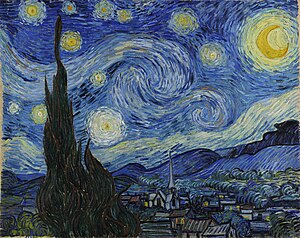
On the subject of stars, perhaps the most famous work on them is Vincent Van Gogh's 'Starry Night'. I remember studying this painting in primary school, and being swept away by the beauty and sur-reality of it. I'm actually not a great fan of impressionistic art work, but something about 'Starry Night' really speaks to me. In some ways, I feel that I can see what Van Gogh saw the night he put his brush to his easel and painted what is now a classic artwork. He saw his dreams reflected in those tiny, pin-pricks of light strewn across the vast blackness. Unfortunately, Van Gogh's life was cut short by his eventual suicide, but his dreams live on in his artwork. This is how I see the stars now, as a reflection of my dreams, glowing brightly, waiting for me to catch them.

'Starry Night' by Vincent Van Gogh

I found another image on the internet called 'Starry Night Reimagined', which also struck a chord with me. It is a digital artwork, which shows an artist's impression of what Van Gogh might have seen the night he painted his masterpiece.

'Starry Night Reimagined'

I don't know who created this artwork, but all credit to them, this is a stunning digital work. Amazing what some people can do with computers, isn't it?

I could go on all night about stars, and how they remind me of my dreams and, by extension, the person I love, but I won't. That would be boring, but, my darling, if you come to me, I promise, from Pluto all the way to Mars, I'll write your name in silver stars.

"For my part, I know nothing with any certainty, but the sight of the stars makes me dream."
~ Vincent Van Gogh

~ Australian Kiwi


Sunday, September 9, 2012

Are we too literal?

Have we, as readers, become too literal in our interpretation of the written word?

I recently publish a poem in my writing community which was originally titled 'A White Clad Woman All Aflame', and was accompanied by the picture below.

A Suicide for the Strong by Sarah Ann Loreth

A white clad woman all aflame,
Deadly sparks dancing in her hair.
Burning with lies, secrets and shame,
Yet she stands still without a care.

Deadly sparks dancing in her hair,
Greedy red tongues licking her skin.
Yet she stands without a care,
On the brink of total ruin.

Greedy red tongues licking her skin,
But she gives not one single cry.
On the brink of total ruin,
And here she stands prepared to die.

But she gives not one single cry,
Burning with lies, secrets and shame.
And here she stands prepared to die,
A white clad woman all aflame.

I intended the poem to be a metaphor for the innocence we lose as we grow from children to adolescents, and then to adults. The 'white clad woman' is innocence, and she is being burned by the fire representing the challenges we face as we grow up, the 'lies, secrets and shame'. Eventually there will be nothing left of her, hence she stands 'on the brink of total ruin' and 'prepared to die' as we must all shed our innocence and step out into the wider world at some point in our lives. 'She gives not one single cry' because she understands that she has now served her purpose for this person in this world, and will go and bestow her gifts upon another.

So, this was my intention. I published the poem and then went away to read a book for a while, when I came back and checked my reviews, I was shocked when I read review after review saying how disturbing my poem had been, and how my reviewers could not imagine anyone setting themselves alight. What was obvious to me was not obvious to them. I quickly replied to all the reviews, explaining my intention, and changed the title of my work to 'Innocence is Burning' and explained my metaphors in the author's notes section. 

But, here is what gets me.

Poetry lives on the metaphor. Without the metaphor, a poet cannot write, and when a reader takes a poem literally, they destroy the metaphor, and thereby destroy the work of the poet. 

To illustrate my point further, I will use another example. 

Take the poem 'Bright Star' by John Keats. Now, I know my poetry is certainly not in the same league as that of John Keats, but my point still stands. If you read 'Bright Star' literally, then we read John Keats' commentary on a star, which is very nice, but not the point of the poem. It is well known that Keats wrote the poem about Fanny Brawn, who he was deeply in love with, and not about a star. He uses the metaphor to compare her to a star, comparing her with the celestial bodies 'hung aloft the night', but we do not take his poem literally and say that John Keats was in love with a glowing ball of gas millions of miles away!

So, do you see my point? If poetry is taken literally, without the metaphor, it dies, plain and simple, and the day poetry dies will be a sad day for the human race.

~ Australian Kiwi

Friday, July 27, 2012

The Reunion of Hektor and Andromache

Through fields brooks run bubbling,
In soft daylight sweet birds do sing.
The grasses here forever green,
No sorrow have these fields seen.
Under skies of blue, brave men talk,
While arm-in-arm their women walk.


There is no night, no darkness here,
The souls do walk all free of fear.
To this place all heroes are bound,
Their shades step softly on the ground.
They indulge in earthly pleasures,
In Elysion, full of treasures.


But one great man steps lonely here,
His wringing hands once cast a spear.
He mourns and weeps all for his wife,
Whom he did cherish most in life.
Across his heart her name engraved,
Andromache who Greeks enslaved.


Under Troy's walls he met his doom,
She was taken to ply the loom.
She lay within her master's bed,
And none could count the tears she shed.
While Hektor waited here alone,
Her ghastly fate he did bemoan.


The other souls they whisper soft,
Great Hektor, he does look so lost.
He cries for dear Andromache,
And would do anything for she.
He'd free her from the world above,
And shower her with tender love.


Most wretched Karon's boat draws near,
He comes not even once a year.
A woman garbed in deepest blue,
Does sail slowly into view.
Upon her lips a haunting song,
Of one who has known many wrongs.


But, who is she that steps ashow?
Bold Hektor, shed your tears no more!
The woman garbed in deepest blue,
In Andromache come to you.
Walk forward, take her in your arms,
Protect her now from every harm.


Andromache, my lovely wife,
Without you all I've known is strife.
Long age were we torn apart,
And bleeding freely was my heart.
But now to have you safe once more,
I will know joy forevermore.


Oh Hektor, husband, bold and strong,
When you were lost the days were long.
I wept bitterly for my fate,
Forced to serve those I did hate.
But we are reunited now,
To feel grief, I know not how.


Come walk with me, Andromache,
For there is much here you must see.
The grasses here are always green,
Cold moonlight never casts her beam.
Warm sunlight here does always shine,
Now with you, Elysion's fine.

So his dear wife stretched out her hand,
And Hektor led her through the land.
He himself saw all with new eyes,
Saw that Elysion told no lies.
That in this place was bliss and joy,
As he had known in windy Troy.


Dear husband, stop, one moment please,
Andromache fell to her knees.
Brave Hektor knelt before her now,
And very gently kissed her brow.
I fear I may awake from this,
Forced again to serve a mistress.


Up on his feet bold Hektor got,
No, slavery is not your lot.
Andromache, come stand with me,
This is no dream, I'll prove to thee.
He lifted her up on her feet,
And kissed her gently, long and deep.


Now when at last they broke apart,
Joy did fill Andromache's heart.
You could not dream that kiss, my love,
Were you still trapped in the above.
This is the truth, I tell you so,
You left that world long, long ago.


My Hektor dear, I love you true,
I am so glad I came to you.
I have left heartbreak and toil,
And dwell now on blessed soil.
Now promise me we'll never part,
And heal now my broken heart.


Andromache, this I do swear,
My leaving you need never fear.
Together here we will now dwell,
To grief and sorrow, bid farewell.
Come close my dear, and kiss me now,
Seal with your lips my spoken vow.


She kissed him gently on the lips,
He placed his hands onto her hips.
He pulled her close and held her tight,
As he once did in Troy at night.
They lay together once again,
And both loved now as they had then.


For since his wife came to his side,
Not one tear has bold Hektor cried.
They spend their days in bliss and peace,
Their laughter never seems to cease.
Forever now they'll not know pain,
Or tears like bitter, winter rain.


Through fields brooks run bubbling,
In soft daylight sweet birds do sing.
The grasses here forever green,
No sorrow have these fields seen.
For now Andromache abides,
Forever young at Hektor's side.

This is a poem I wrote this afternoon. It's the longest poem I've ever written, seven hundred and twenty nine words! It deals with my two favorite characters in the Trojan War cycle, Hektor, and his wife Andromache. I will honestly say that it bothers me that the Trojans, who did everything right, were the ones who lost the war. They were noble, upstanding, gracious, and fought honestly. 

How many of us imagine Hektor and Andromache. Eric Banna 
as Hektor and Saffron Burrows as Andromache in the 2004 film
'Troy'

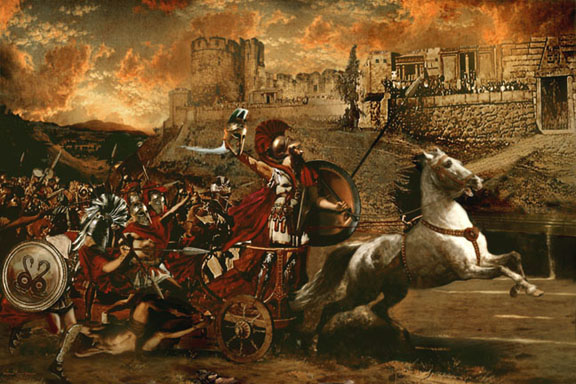
It annoyed me the first time I read the Iliad that it was Hektor who was slain when he fought Achilles, Achilles who had sulked in his tent and packed a sad because Agamemnon had stolen his slave girl. Achilles blamed Hektor for the death of Patroklos, but if Achilles hadn't been so besotted with his own importance, then Patroklos would never have gone out impersonating him, never would have faced Hektor, and never would have died. So, the real fault for Patroklos's death lies with Achilles. 

So, after defeating Hektor, Achilles has a chance to prove he is as noble as the Trojans, rather than a sulking child, but, instead, he pushes this aside and desecrates Hektor's corpse. When I talk to people who call Achilles a hero, I ask them whether heroes desecrate corpses. Most people stop talking to me at that stage and say I take the Iliad too seriously but, hey, I'll be the first to admit they're right. I do take the Iliad seriously. Furthermore, Achilles has left his 'dear comrade' Patroklos unburied for days! Without proper rites, Patroklos's shade cannot pass into the Underworld and achieve peace. It is only when Patroklos's ghost appears to Achilles and demands to be buried that Achilles grants his friend rest. Achilles does eventually return Hektor's corpse to the Trojans so they can hold a proper funeral for him, but the damage has been done.

'Achilles Triumphant' by Howard David Johnson

The Iliad ends with Hektor's funeral, where his mother, his wife, and Helen of Troy lament over him. But, later on in the Trojan War cycle, Paris kills Achilles with his bow. Achilles corpse is rescued by his countrymen, and they bury him with full honours. But, to make matters even worse, Achilles achieves Elysion! The isle of the blessed, where the virtuous and glorious go after they die, to live in peace and bliss forever. There is no mention in any of the epic cycles that Hektor, a much greater hero than Achilles, achieves Elysion. After his funeral, Hektor is very much brushed aside by the epic poets. Andromache merits a few mentions in later epics, when she is taken as a slave-concubine by Achilles's son, Neoptolemos. For Hektor and Andromache, the one couple in the Iliad who love rather than lust (Paris and Helen, and Achilles and Briseis personify lust), there is no happy ending. This has always bothered me.

T'he popular image of Achilles. Brad Pitt as Achilles in
the 2004 movie 'Troy
Even to the ancients, Achilles's treatment of Hektor's corpse was unspeakably vile. The Greeks prided themselves on being civilized, and to desecrate a corpse was an act of absolute barbarianism. While in early literature, Achilles achieves Elysion, in later poems he is depicted as just another soul wandering the Asphodel Meadows, where the ordinary folk go after death. This is clearly a much more acceptable place for a man who desecrates corpses and leaves his friends unburied. In truth, for these crimes, Achilles should have been sent to Tartaros, the hell of the ancient Greek world, but a hero like Achilles could not be thrown into Tartaros. The Asphodel Meadows are the happy medium between honoring a man who behaves like a barbarian, and punishing a hero.

So, what does all this have to do with my poem? Well, as I mentioned above, the fact that Hektor and Andromache never got a happy ending always upset me. They were a wonderful couple, and devoted parents to their son, Astyanax. But, because they were Trojans and, therefore, 'the enemy' they did not deserve the happy ending afforded to the Greek heroes. So, that is why I wrote the poem, to give them a happy ending. Andromache has been living a life of drudgery since she was taken from Troy, serving the man who killed her son, and the son of the man who killed her husband. By reuniting her with Hektor, who I have placed in Elysion, there is an end to her life of slavery, and a happy ending. She and the husband she loves can now spend eternity together in peace. 

'Elysium' by Unknown Artist. Elysium is the Latinization of
the Greek Elysion.

So, that was the point of my poem, to give the story of Hektor and Andromache a happy ending. I have written short stories where Andromache escapes Neoptolemos, but have never concluded them with her death and reunion with Hektor. I feel that, if anyone deserves a happy ending, it is Hektor and Andromache.

~ Australian Kiwi   

P.S. I've used two images from the 2004 film Troy, but I don't actually like that movie. It was a combination of bad directing, bad scripting, bad acting, and faithlessness to the source. I've seen the first hour or so, but it was so terrible that I had to turn it off. I have no intention of watching the rest of the movie, I have better things to do with my time than watch  bad movies.  

Tuesday, June 12, 2012

"Soft Moonbeams Shimmer" by Australian Kiwi

Soft moonbeams shimmer in the night,
When silver stars are all aglow.
Now sun is gone, all tucked up tight,
Soft moonbeams shimmer in the night.
Bright meteors, oh, what a sight!
And the wise planets surely know,
Soft moonbeams shimmer in the night,
When silver stars are all aglow.

This is a poem I wrote for my writing site FanStory. It is a triolet, a poem of French origin, which has eight lines and a rhyme structure of abaaabab. The fourth and seventh lines repeat the first line, and the eighth line repeats the second line. The artwork accompanying my work is by avmurray on FanArtReview, all rights to them, I am merely borrowing.

If you want to read more of my writing, you can do so by visiting my FanStory profile here. If you want to check out the other awesome, inspiring writers on FanStory, you can do that here.

This is by no means my first poem, but it was the first triolet I ever wrote, I have written a few more since, in fact, I'm quite fond of them. The triolet and the nove otto are my favourtie styles of poetry. Next time, I'll post a nove otto for you to read.

~ Australian Kiwi